Schedule Your Consultation
with Dr. Prasad Today




TrichoStem® Hair Regeneration
Case Studies
TrichoStem®
Hair Regeneration
Case Studies
Improving hair coverage after multiple hair transplants
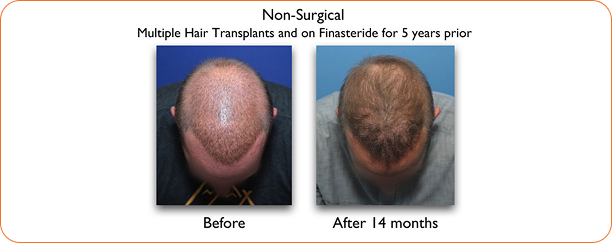
TrichoStem™ Hair Regeneration can increase frontal hair density, notably on patients already on finasteride.
Man had 3 FUT (strip) hair transplants, and 2 FUE hair transplants before he had his first consultation with us at age 39. Although he has been highly DHT-sensitive throughout his adult life, with evidence showing with pattern hair loss at 17, he was only on finasteride 5 years prior to his consultation. With his multiple transplants and rapid rate of hair loss progression, he adopted a short hairstyle to blend his thin native hair with thicker transplanted hair
He had the TrichoStem® Hair Regeneration at age 39. 14 months after a single treatment, at age 40, he achieved thicker and stronger hair that allowed him to wear a longer hairstyle. He claimed that his hair has not felt this healthy in 20 years.
.png)
Thicker hair after the TrichoStem® Hair Regeneration treatment thickened the mix of transplanted and native hair at the frontal hairline, giving a more natural-looking hair density
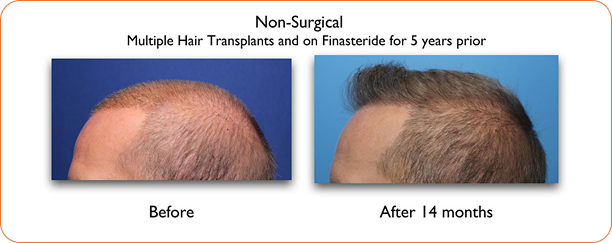
Multiple transplants spaced widely apart, and thin native hair left this man with little hair density. With TrichoStem® Hair Regeneration thickening grafted and native hair, and improving overall hair health, he was able to grow a longer hairstyle and get more hair coverage throughout the head.
This case shows that hair thickness and density can still be improved years after early and aggressive pattern hair loss, and with both native and transplanted hair.
Male age 23 (at time of consultation) Age of onset of hair loss - 21
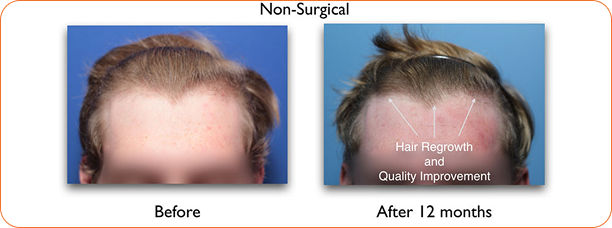
More hair growth was noticed in the frontal hairline, with hair throughout growing thicker and with healthier texture after the TrichoStem® Hair Regeneration treatment.
A 23-year-old man was noticing hair thinning for the past couple of years at his hairline and temple areas, but never decided to take finasteride or use minoxidil to treat it. He came in for consultation, and then received one TrichoStem® Hair Regeneration treatment as well as a prescription for finasteride.
12 months after the treatment and starting finasteride, he had thicker hair growth at his frontal hairline, including very short and fine hairs at his temple now growing long and thick.
.png)
Very fine hairs at the temple area now growing thicker and longer after the TrichoStem® Hair Regeneration treatment.
Treatment of late onset hair loss without finasteride
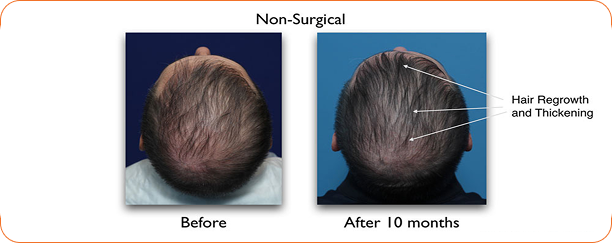
Hair at the scalp and crown grew back thicker 10 months after one TrichoStem® Hair Regeneration treatment. As DHT-sensitivity is not as high in later age of onset of hair loss, finasteride was not prescribed.
Male age 49 at time of consultation Hair loss started about 10 years ago
This 49-year-old man started suffering from hair loss about 10 years prior, so age of onset was pretty late, and his sensitivity to DHT would be classified as moderate. Hair thinning was diffuse throughout the scalp, as well as the temples. He wasn’t on a DHT-blocker like finasteride prior to treatment.
He received one TrichoStem® Hair Regeneration treatment. Since his age of onset was later, and he is not highly DHT-sensitive, using finasteride after treatment was not as critical. He was able to achieve thicker hair growth and greater hair coverage 10 months after treatment, without using finasteride.
.png)
Thicker, longer hair growth was achieved in the frontal hairline from miniaturized hairs and dormant follicles. Darker hair growth can be a side effect of the TrichoStem® Hair Regeneration treatment.
Finasteride is almost always prescribed for men with high DHT-sensitivity, such as those who start losing hair in their late teens, 20s, and early 30s. However men who start losing hair in their late 30s and older are less DHT-sensitive, so a DHT-blocker like finasteride is not always necessary on a case-to-case basis.
Scalp Micropigmentation with Hair Loss
.png)
Progressive pattern hair loss left a 32-year-old man with almost no hair coverage at this area of his hairline, making his scalp micropigmentation look obvious.
Male age 32 (at consultation) Age of onset of hair loss - 27
32-year-old man was concerned about hair thinning due to pattern hair loss after previously having scalp micropigmentation, a scalp tattoo procedure to camouflage the effects of balding. The effects of progressive pattern hair loss made the small tattoos on his scalp more obvious.
5 months after his TrichoStem® Hair Regeneration treatment, where he was also prescribed finasteride, pictures were taken of his results. He was happy with his new hair growth at the frontal hairline, which was previously receding and unveiling his scalp micropigmentation.
.png)
One session of the TrichoStem® Hair Regeneration treatment increased hair growth and thickened thinning hair at the hairline, making micropigmentation less noticeable, and greater hair density without surgery.
Prior finasteride Use
.png)
Thicker hair growth after the TrichoStem® Hair Regeneration treatment allowed this 40-year-old man to have a longer hairstyle, as he previously kept his short to blend thicker transplanted hair with thin native hair.
This man was experiencing diffuse hair thinning all over his scalp, and temporal hair recession starting at 21. He was taking finasteride due this his high DHT-sensitivity, and slow his hair thinning for more than one year prior to his consultation. 4 months after one TrichoStem® Hair Regeneration treatment, his frontal hairline was significantly thicker, and temples had visibly more hair coverage. Hair quality and thickness throughout his scalp was improved, and he remarked how his hair felt healthier.
This study illustrates that stimulated hair growth and thicker hair cannot be achieved with finasteride alone, and that the TrichoStem® Hair Regeneration system works at a different level than finasteride. This also shows that combining the finasteride with the TrichoStem® Hair Regeneration treatment as an effective combination treatment for male pattern hair loss.
.png)
TrichoStem® Hair Regeneration can thicken thinning hair, and restore healthy hair texture and growth, even on patients already taking finasteride.
Contact Us
Oops! Something went wrong while submitting the form.
Explore Our Locations





.svg)
.svg)


.avif)



%201.png)



FOLLOW US

.svg)
.svg)
.svg)