Schedule Your Consultation
with Dr. Prasad Today




Hair Loss FAQs
Frequently asked questions about genetic pattern hair loss, other causes of hair loss, the TrichoStem® Hair Regeneration treatment, and other hair loss treatments.

.png)
01
Why does my hair fall out so easily?
Hair shedding is actually a normal daily occurrence where 50-100 hairs shed
a day, but these shed hairs grow back. Genetic pattern hair loss, the most
common cause of hair loss making up about 95% of cases, is shed hair
growing back progressively thinner, and a delay in regrowth as pattern hair
loss limits the number of hair growth cycles.
Higher than normal hair shedding can be due to one, or a mix of the following: severe stress; genetics; illnesses such as thyroid disease and anemia; nutritional changes; hormonal changes related to puberty; pregnancy; menopause; vitamin D deficiency, or side effects of strong medication (such as chemotherapy).

Daily shedding of 50-100 hairs a day is normal, and shed hair regrows. Pattern hair loss is hair growing back progressively thinner. More severe cases of hair shedding are usually due to temporary conditions, such as hormone imbalances.
02
Why is my hair thinning (male and female)?
Genetic pattern hair loss is the most common cause of hair thinning in men, and women. While hair thinning is most commonly associated with men, there are actually more potential causes for hair thinning in women.
A major factor of pattern hair loss in men is the genetic scalp sensitivity to the hormone dihydrotestosterone (DHT). While DHT-sensitivity is an important factor in male pattern hair loss, it’s not the only factor, otherwise a DHT-blocker could reverse hair thinning, when in reality a DHT-blocker just slows it down. We’ve also thickened thinning hair in men who’ve been unwilling to take a DHT-blocker with the TrichoStem® Hair Regeneration treatment, although a DHT-blocker is still prescribed for male patients for best results, as TrichoStem® Hair Regeneration is not a DHT-blocker.
.png)
Male pattern hair loss is the most common cause of hair thinning in men, with scalp DHT-sensitivity being a major factor.
Why is my hair thinning (women)?
Genetic pattern hair loss is the most common cause of hair thinning in women. The exact cause of female pattern hair loss is still unknown, but it is treatable with TrichoStem® Hair Regeneration, so thinning hair grows back thicker, and dormant hair follicles currently not growing hair can be stimulated to grow hair again, without the need for additional medication such as minoxidil, or spironolactone.
.png)
The most common cause of hair thinning in women is genetic pattern hair loss, but there are more potential causes of hair thinning for women than there are for men.
03
How many strands of hair fall is normal in a day?
It is normal to shed 50-100 hair strands a day, and these hairs do grow back.People with genetic pattern hair loss have their hair growing backprogressively thinner after the shedding cycle, and also may have delay inregrowth as pattern hair loss limits the number of hair growth cycles.
.png)
Shedding 50-100 hairs a day is a normal part of the hair shedding/growth cycle, and shed hair regrows. Genetic pattern hair loss causes hair to grow back thinner after shedding, and also delays regrowth.
04
Is there a difference between male and female hair loss?
Both men and women can experience androgenetic alopecia, which is caused in both sexes by genetics. Hair loss often occurs faster and more extensively in men. Men may manifest pattern hair loss as early as their late teens, which is more aggressive the earlier its onset. Male pattern hair loss is generally more pronounced, with onset of hair recession near the temples, and theappearance of the characteristic “M” shaped hairline.
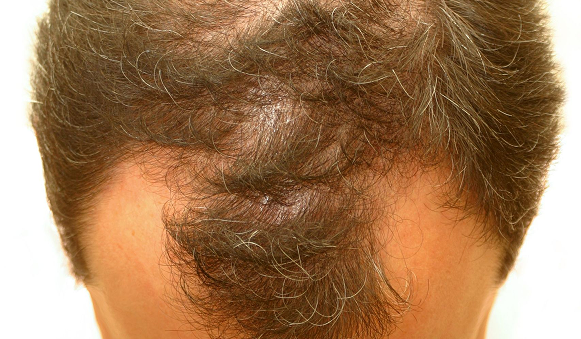
Male pattern hair loss most often has hair thinning starting in frontal hairline, temples, and crown, and eventually the mid scalp with an M-shape, or horseshoe pattern
Pattern hair loss in women is more subtle, with diffuse thinning throughout the top of the scalp, often noticeable as the hair part widens. Female pattern hair loss can manifest as early as the mid-teens. Female pattern hair loss generally has a slower progression than men, although there are exceptions of aggressive hair thinning in women.
.png)
Female pattern hair loss usually manifests as hair thinning throughout the top of the scalp, with the hairline being preserved, and the hair part progressively widening.
05
Can stress cause hair loss?
Severe stress can cause temporary hair shedding, which is called telogen effluvium, but stress on its own cannot cause genetic pattern hair loss, or permanent hair loss. The mild stress we experience on a day-to-day basis is not enough to cause hair loss. Severe stress that can trigger telogen effluvium is usually serious or traumatic events, such as divorce, a death in the family, a drastic change in diet causing internal stress, extreme weight loss taxing the body, or even the severe stress on the body caused by an illness. This physiological trauma often leads to hair shedding because it “shocks” your body’s normal routine, so natural functions are disrupted, including your natural hair shedding, and growth cycles. The sudden physiological changes in your body may trigger a larger amount of hairs on your head to go into a “resting phase”, resulting in severe hair shedding, with a lack of regrowth. However, telogen effluvium is a temporary condition, with severe shedding usually occurring about 3 months after the stressor that triggered it, and full regrowth of shed hair occurring 3-6 months after the start of the severe shed, without medical treatment.
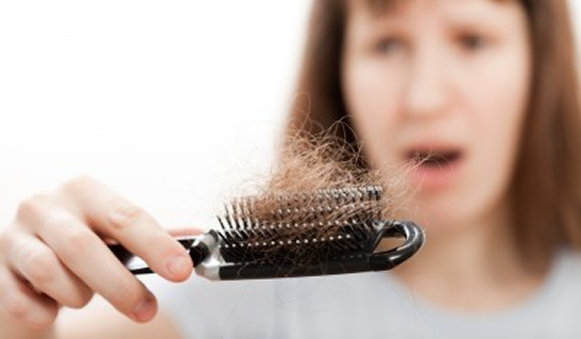
Extreme stress can trigger temporary, but severe hair shedding called telogen effluvium. As long as there is no concurrent cause of hair loss, telogen effluvium is fully reversible without medical treatment.
06
Can shampooing cause hair loss?
Shampooing with over-the-counter, reputable shampoos only loosens hair that is ready to shed, and will not cause hair loss. Daily shampooing does not cause hair loss.

Shampooing with reputable over-the-counter shampoos will not cause hair loss, even when done daily. Shampooing only loosens hair shafts that are ready to shed.
07
Can hairstyling cause hair loss?
Most hairstyles will not cause hair loss. However, excessively tight hairstyles that place tension on hair follicles such as tight ponytails, and braids can cause a hair loss condition called traction alopecia. As these hairstyles place constant tension on hair follicles, the follicles progressively weaken, and once injured to a certain threshold, can no longer grow hair, resulting in permanent hair loss.
.png)
Tight hairstyles that place constant tension on hair follicles can cause a permanent hair loss condition called traction alopecia.
TrichoStem® Hair Regeneration has helped some people with tractionalopecia combined with pattern hair loss achieve some unexpected hairgrowth in areas of scalp affected by tight hairstyles.
.png)
TrichoStem® Hair Regeneration has successfully treated cases of traction alopecia combined with pattern hair loss, but this is done on a case-by-case basis.
08
How is male pattern baldness treated?
Common treatments include topical, and oral medications, like over-the-counter minoxidil (Rogaine), and prescription-only DHT-blocker(Propecia). Minoxidil seems to delay the natural hair shedding cycle, and extends the growth cycle, so more hair appears on the scalp. Minoxidil does not directly treat hair thinning. The effects of minoxidil are unsustainable as a severe hair shed can occur if daily use is stopped, or if the effects of the drug wane with time, so gains from minoxidil are easily lost. A DHT-blocker is more effective long-term as it blocks the conversion of testosterone to dihydrotestosterone (DHT) to slow hair thinning. A DHT-blocker alone has a limited effect in thickening thinning hair, demonstrating that DHT-sensitivity is an important factor, but not the only factor in male pattern hair loss. Injections of PRP alone are also used to stimulate hair growth, but constant treatment sessions are needed, and many people don’t see results.
Since 2011, TrichoStem® Hair Regeneration has proven to thicken thinning hair, and stimulate dormant hair follicles to grow hair again in over 99% of male pattern hair loss patients. Even patients on a DHT-blocker for years prior to our treatment see their hair grow thicker compared to a DHT-blocker alone. All TrichoStem® Hair Regeneration patients can stop using minoxidil completely. Unlike PRP alone that needs constant treatment sessions with no clear end to treatment, and inconsistent results, TrichoStem® Hair Regeneration uses PRP, but not as its main ingredient, with only 1-2 treatment sessions needed, with results lasting 3-5 years, or even more, and with consistently better results than PRP alone.
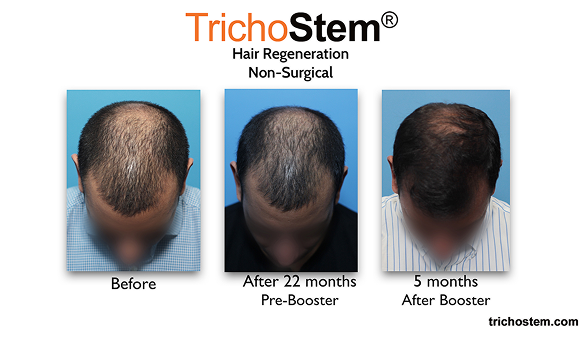
TrichoStem® Hair Regeneration can go beyond a DHT-blocker alone to actually thicken thinning hair, and can achieve more hair density than is possible with surgical hair transplants.
09
How is female pattern hair loss treated?
Up until recently, female pattern hair loss has had less treatment options than men. A DHT-blocker is usually not prescribed to women as DHT-levels in women are generally low, and a DHT-blocker can have a serious impact on a developing male fetus in pregnant women. This left past treatment options only with minoxidil, and the prescription testosterone blocker spironolactone. Minoxidil doesn’t treat thinning hair directly, but appears to delay the hair shedding cycle, and extend the hair growth cycle so the scalp has more hair strands for a fuller appearance. The effects of minoxidil are easily lost as these gains need daily application to sustain, but gains can also be lost as minoxidil’s effectiveness wanes in most people. The testosterone blocker spironolactone is prescribed off-label as a female pattern hair loss treatment, but most don’t see results with the drug. Platelet-rich plasma injections (PRP) are also used to stimulate hair growth, and have some effect on thickening thinning hair, but treatment sessions are constantly needed, results don’t last long, and many women don’t see improvement in their hair.
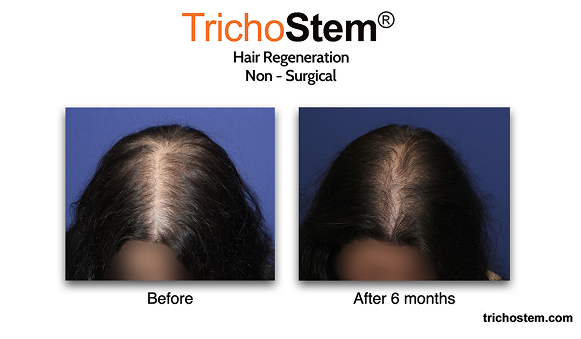
TrichoStem® Hair Regeneration can be a standalone treatment for female pattern hair loss, without needing minoxidil, or spironolactone.
TrichoStem® Hair Regeneration was a breakthrough treatment for female pattern hair loss because it’s far more effective, and convenient than the limited options for treatment. Our treatment was able to break the frustration of female pattern hair loss sufferers, as now there is a treatment that can thicken thinning hair, and stimulate dormant hair follicles to grow hair again. TrichoStem® Hair Regeneration can be a standalone treatment for female pattern hair loss in most women, as minoxidil or spironolactone are not needed after our treatment. TrichoStem® Hair Regeneration does use PRP, but not as its main ingredient, so unlike treatment sessions needed every 1-3 months indefinitely, only 1-2 treatment sessions are needed, with benefits lasting 3-5 years, or even longer.
Female pattern hair loss is not easily diagnosed as male pattern hair loss, as there are more potential causes of hair thinning in women than there are for men. While most cases of hair thinning in women are due to pattern hair loss, polycystic ovarian syndrome (PCOS), also called polycystic ovarian disease (PCOD) is a common cause of hair thinning affecting women. Hair thinning due to PCOS/ PCOD is reversible, but treatment is completely different from pattern hair loss. To definitively diagnose female pattern hair loss, several biopsy points must be taken from the scalp, which are sent to a respected university pathology department specializing in hair to ensure a correct diagnosis. When properly diagnosed, the TrichoStem® Hair Regeneration treatment has helped increase visible hair growth, thickness, and scalp coverage in over 99% of female pattern hair loss patients.
.png)
Only 1-2 treatment sessions are needed for the benefits of TrichoStem® Hair Regeneration to last 3-5 years, and beyond.
10
What is the right age for a hair transplant?
Hair transplants are generally not advised for female pattern hair loss because the diffuse thinning pattern means hair follicles are close together that implanting hair grafts will likely permanently damage those follicles, causing more hair loss.
Hair transplants are not advised for men in their 20s because transplants cannot keep up with rapid hair thinning, and transplants can’t match hair scalp coverage of the men in the age group without pattern hair loss.
In men, it’s important to know the differences of pattern hair loss manifesting in the 20s compared to the 40s and older. Early onset of male pattern hair loss in the 20s usually means a high level of DHT-sensitivity, and an aggressive, rapid pattern of hair thinning compared to a man in his 40s with a slower rate of thinning. Pattern hair loss in men follows the Rule of Decades, with 20% of men in their 20s experiencing pattern hair loss, 30% in their 30s, and so on. This means that men in their 20s expect transplant results to match their peers who don’t have pattern hair loss, but this isn’t possible as they are losing hair faster than it can be transplanted. If hair transplants start in the 20s, men will undergo several transplant surgeries to try and keep up with peers, while hair continues to thin. By the time they’re in their 30s, they will have no donor hair left, and only sparse hair coverage that looks unnatural.
.png)
Hair transplants are not advised for men in their 20s because transplants cannot keep up with rapid hair thinning, and transplants can’t match
The minimum age range for a hair transplant in men is in the 30s. The hairloss pattern is more pronounced at this age, and expectations for haircoverage among their peers are more realistic. TrichoStem® Hair Regeneration can be performed for men in their 20s, usually with a DHT-blocker as part of their treatment plan because a it is important for younger men with high DHT-sensitivity that leads to an aggressive thinning pattern.
.png)
TrichoStem® Hair Regeneration, along with a DHT-blocker is a more appropriate treatment plan for men in their 20s than hair transplant surgery.
11
Is it possible for grafts to fall out after hair transplant?
It is not unusual for a few hairs to be shed after hair transplantation. Sometimes, when a scab flakes off, it can cause hair breakage without affecting the actual grafts. Keep in mind that the grafts are deeply embedded under the skin and must be physically cut out in order for it to be non-viable. It is also important to remember that it is highly unlikely that the follicle or the dermal papilla (the key part of hair) will fall out.
There are hair grafts that are damaged during harvesting that don’t take to the scalp. Follicular unit extraction (FUE) hair transplants harvest grafts individually, most often using a punch extractor. Hair grafts can be damaged at the root by the sharp punch, or the root stretched when harvesting. Damage to hair grafts, which can be as high as 30% in FUE surgery, means that they don’t take to the scalp, and grow to its full length.

Up to 30% of grafts in follicular unit extraction (FUE) hair transplants can be damaged in the harvesting process, and won’t grow hair even if they are implanted.
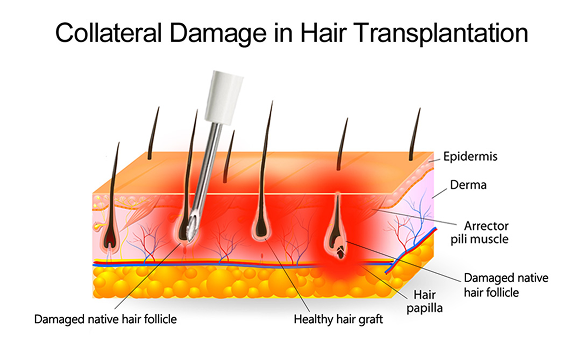
Collateral loss in hair transplant surgery is often not discussed by transplant surgeons. Collateral loss is when hair grafts are implanted too close to native hair follicles, and damaging those follicles permanently, causing more hair loss. This is often justified by other transplant surgeons since the damaged follicles were growing thinning hair, so they would be lost anyway. However, with TrichoStem® Hair Regeneration, every thinning hair that can be thickened and saved is hair that doesn’t need to be transplanted.
Hair grafts can be pushed out by high blood pressure during hair transplant surgery, which is known as “popping”. As a hair transplant surgeon, Dr. Prasad would avoid this by relaxing his patients with LITE IV sedation to keep them relaxed, but awake during hair transplant surgery so grafts stay in place.
.png)
Collateral loss of native hair during hair transplants is not often discussed, as many transplant surgeons justify it since native hair is already thinning. Saving and thickening thinning hair makes each hair valuable, and one saved doesn’t need to be transplanted.
12
What is the difference between hair transplants and hair weaving? Which treatment should I opt for?
Hair weaving refers to the attachment of synthetic or human hair to a person’s existing hair to achieve the appearance of longer or thicker hair. Hair transplantation refers to a procedure wherein grafts of a person’s own hair is surgically removed from their head, and is transferred to another area where hair is lacking.
13
Are hair transplants a temporary or permanent answer for my baldness?
Hair transplants by themselves do not treat progressive hair loss. What hair transplants do is move hair from the back of the head, to the front in areas that have lost hair. Progressive thinning of native hair, and even some transplanted hair continue after a hair transplant.
Visible “hair plugs” indicate why hair transplants are not permanent. Even with grafts genetically resistant to hair thinning, the surrounding native hair continues to thin, and are eventually lost, leaving only visible plugs of hair.
.png)
Visible hair plugs are due to progressive hair thinning around hair grafts that have genetic resistance to hair thinning. Hairs resistant to hair thinning only grow in a narrow band at the back, and sides of the head.
When follicular unit transplantation (FUT) or the “strip” method was more popular, hair grafts were only harvested from a small area at the back of the head called the “permanent zone” because these hairs are genetically resistant to thinning. However, follicular unit extraction (FUE) surgery became the dominant procedure because it avoided excising a strip of skin to harvest grafts from the permanent zone. FUE transplants harvest grafts from a wider area of the scalp, and outside the permanent zone to avoid a larger scar, so some hair grafts used in FUE transplants are also prone to hair thinning.
A major advantage of TrichoStem® Hair Regeneration is that native hair, and hair grafts prone to thinning are thickened, and saved, so not only does it improve hair transplant results, and treat ongoing progression of thinning hair, but it also makes hair transplant results last longer.
.png)
Native thinning hair, and even FUE transplant hair prone to thinning can be thickened by TrichoStem® Hair Regeneration, greatly improving scalp coverage even after multiple hair transplants.
14
What to do with scabs after hair transplant?
After hair restoration procedures, patients are afraid of doing anything that might hurt their grafts. The scabs and crusts are basically dead skin cells, mucus and other products of the healing process. To keep hair healthy, they have to be properly scrubbed off with a proper moisturizer and a good shampoo. The scabs usually disappear after a couple of weeks.
15
How can I get my hair in better condition?
It’s important to remember that genetic pattern hair loss is a genetic condition, and is not due to diet/nutrition, or any type of behavior.
There is no harm in having a well-balanced diet and consuming an adequate amount of vitamin B, vitamin D, and iron. Getting regular checkups to diagnose and address any underlying causes, such as anemia or thyroid disease, is another mode of prevention one should consider.
Contact Us
Oops! Something went wrong while submitting the form.
Explore Our Locations






.svg)
.svg)


.avif)





%201.png)






FOLLOW US

.svg)
.svg)
.svg)