Schedule Your Consultation
with Dr. Prasad Today




TrichoStem®
Hair Regeneration FAQs
TrichoStem®
Hair Regeneration
FAQs
Frequently asked questions about genetic pattern hair loss, other causes of hair loss, the TrichoStem® Hair Regeneration treatment, and other hair loss treatments.

.png)
“The ECM works I now have
a full head of hair”
– L.D.
01
Does TrichoStem® Hair Regeneration cure hair loss permanently?
As indicated in its name, genetic pattern hair loss is a genetic condition. This means that genes that contribute to pattern hair loss are hardwired into the DNA, so it can’t be completely cured. A “cure” would also indicate that all hair that is permanently lost from fully miniaturized hair follicles can be recovered, which simply isn’t possible as hair follicles are tiny, individual organs. However, TrichoStem® Hair Regeneration can thicken thinning hair, and stimulate hair growth from dormant hair follicles that are still viable, but currently not growing hair, which it can do better than any other treatment in the market. Treatment of genetic pattern hair loss is about management to maximize hair thickness and growth as much as possible, for as long as possible.
.png)
Genetic pattern hair loss cannot be fully cured since it’s hardwired into the DNA, but it can be managed so thinning hair can be thick as possible, and hair growth maximized for as long as individual genetics allows.
02
How is the TrichoStem® Hair Regeneration treatment performed?
TrichoStem® Hair Regeneration is a convenient, non-surgical procedure wherein a customized formulation consisting of: ACell’s extracellular matrix, platelet-rich plasma (PRP), vitamin D, and other customized ingredients such as anti-inflammatory medication, is injected into the scalp. Before the Trichostem® injections take place, platelet-rich plasma is prepared from the patient’s own blood, and topical anesthetic is placed on the scalp. After the hair treatment injections are performed, the scalp is massaged. The entire preparation and procedure takes about 2 hours. The actual Trichostem® Hair Regeneration injections take a few minutes.
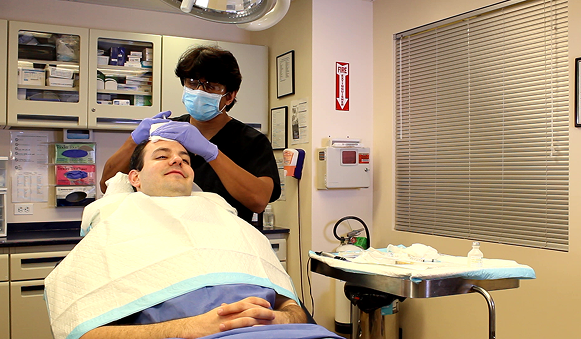
TrichoStem® Hair Regeneration is performed with topical, and injectable anesthetic for patient comfort, with only 1-2 treatment sessions are needed for benefits to last 3-5 years, or even longer.
03
Does the TrichoStem® Hair Regeneration treatment regrow hair naturally?
Yes, TrichoStem® allows the natural regrowth of hair. When injected, the TrichoStem® Hair Regeneration appears to trigger a natural wound-healing response which reactivates dormant hair follicles. Hair follicles that are progressively growing thinner hairs prior to treatment, appear to shed and thicker hair grows in. The Trichostem® Hair Regeneration treatment wound healing response triggers your body to produce its own adult stem cells, which appears to revitalize hair follicles and healthy hair growth. Trichostem® Hair Regeneration does not use drugs in the formulation to stimulate hair growth.
.png)
In addition to thickening thinning hair, TrichoStem® Hair Regeneration can stimulate growth from dormant hair follicles that stopped growing hair prior to treatment.
04
What are the benefits of TrichoStem® Hair Regeneration over other hair loss treatments?
A Better Alternative to Hair Transplant Surgery
TrichoStem® is a non-surgical treatment that appears to change the hair thinning, and hair follicle miniaturization process hair with a wound-healing mechanism to reinvigorate, and renew the hair growth cycle so thinning hair can grow back thicker, and follicles not completely miniaturized can be saved, and stimulated to grow hair again. Since natural hair density grows very tightly together, even if hair is thinning, and native thinning hairs have far greater numbers than available hair grafts, saving, and thickening thinning hair can provide more scalp coverage, and greater density than hair transplant surgery, and even multiple transplant surgeries. The majority of TrichoStem® Hair Regeneration patients are able to avoid having hair transplant surgery altogether after the injection treatment.
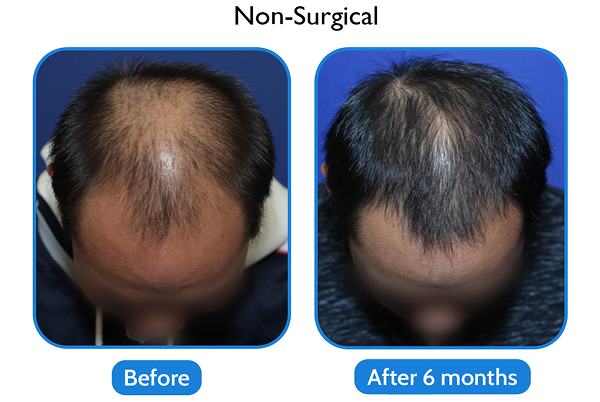
Native hair, even when thinning, is more numerous, and more densely packed together than transplanted hair grafts, so maximizing thickness of native hair covers more scalp than hair grafts.
Maximizing Hair Thickness and Growth for Advanced Hair Loss Cases
Some patients with more advanced hair loss can use TrichoStem® Hair Regeneration before they undergo hair transplant surgery. This approach involves thickening thinning hair, and maximizing growth from remaining viable hair follicles in areas that would otherwise receive transplanted hair. Even if hair is thinning, these thinned hairs naturally grow more tightly together, so thickening them TrichoStem® Hair Regeneration can create more hair density than is possible with hair transplant surgery. Also with this strategy, the precious few hair grafts can be concentrated in areas of completely miniaturized follicles, where they are needed most, so overall scalp coverage is greater than hair transplant surgery alone.
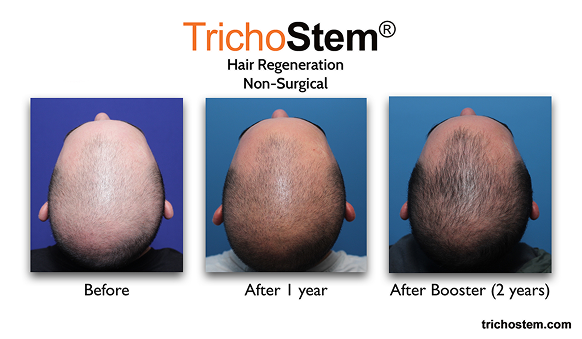
For advanced hair loss, TrichoStem® Hair Regeneration can maximize growth, and thickness of existing hair first, so if a hair transplant is considered, limited hair grafts can be placed where needed most.
Improving Past Hair Transplant Results
TrichoStem® Hair Regeneration can also be done to improve results of previous surgical hair transplants. If done within 1-2 months after a surgical hair transplant, the treatment can help with healing of hair grafts, as well as healing of the donor area. The treatment also thickens native hair surrounding transplanted hair, and transplanted hair harvested from outside the permanent zone that are prone to hair thinning. Surgical hair transplants alone don’t treat progressive hair thinning, so with TrichoStem® Hair Regeneration not only are transplant results improved, but they are improved long-term. By thickening thinning hair, and stimulating hair growth from hair follicles that would otherwise further miniaturize, patients improve their overall hair transplants results for the long-term, so they can avoid another hair transplant surgery.
.png)
Men who’ve had past hair transplants, and taking a DHT-blocker for years benefit from TrichoStem® Hair Regeneration thickening their native, and transplanted hair
05
How effective is TrichoStem® Hair Regeneration?
TrichoStem® Hair Regeneration’s has a success rate of over 99%, based on men, and women suffering from pattern hair loss (androgenetic alopecia) seeing increased scalp coverage. Just a handful of male patients have not responded to treatment. Our success rate for women also reached over 99% after better diagnosis methods, as women have more possible causes of hair thinning than me.

TrichoStem® Hair Regeneration also has a 99% success rate in treating female pattern hair loss, but diagnosis is especially important since there are more potential causes of hair thinning in women compared to men
Other treatments of platelet-rich plasma (PRP) alone, other ACell+PRP treatments, other scalp injection treatments like growth factor concentrate (GCF), and proprietary and branded treatments require constant treatment sessions, TrichoStem® Hair Regeneration only requires 1-2 treatment sessions, with the second treatment when needed done 15-24 months after the first, with benefits lasting 3-5 years. We can achieve more hair thickness, more hair regrowth, but with more convenience for patients.
For men, especially those with early onset of pattern hair loss, and an aggressive hair thinning pattern, a DHT-blocker like is regularly prescribed to prolong, and improve results. Young men with high DHT-sensitivity, and refuse a DHT-blocker may not get the same lasting results as men with lower DHT-sensitivity (such as male TrichoStem® Hair Regeneration patients with later onset of hair loss in their 40s and older, who may have opted not to take a DHT-blocker), or younger men taking a DHT-blocker after the TrichoStem® Hair Regeneration treatment. All patients don’t need to use minoxidil after the TrichoStem® Hair Regeneration treatment.
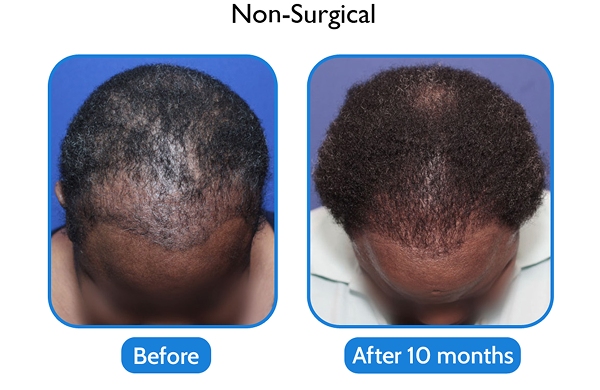
TrichoStem® Hair Regeneration can achieve thicker hair, and more hair growth in men who were already taking a DHT-blocker prior to the injection treatment.
Women under 50 can have TrichoStem® Hair Regeneration as a standalone treatment, and not require additional medications like the testosterone blocker spironolactone, or minoxidil. Women over 50, or women who’ve already undergoing perimenopause or menopause with decreased estrogen levels, may see additional benefit with hormone replacement therapy, as estrogen is important for hair growth and health.
TrichoStem® has been successfully used for conditions other than genetic pattern hair loss, such as diffuse unpatterned alopecia (DUPA), traction alopecia, and alopecia areata, but these situations are approached on a case-by-case basis.
.png)
Some concurrent hair loss conditions like traction alopecia with androgenetic alopecia can be successfully treated with TrichoStem® Hair Regeneration on a case-by-case basis.
06
Who can use TrichoStem®? Is there a minimum age requirement?
TrichoStem® Hair Regeneration is usually recommended for adult men, and women with diagnosed androgenetic alopecia (genetic pattern hair loss). Generally, we don’t treat anyone under 18, with a few exceptions in female pattern hair loss being treated as young as 16. Men under 18 can’t take a DHT-blocker since it is important for male physical development, but younger men with early onset of pattern hair loss are generally the most DHT-sensitive, so the drug can be prescribed at the minimum age of 18.
.png)
Minimum age for the TrichoStem® Hair Regeneration treatment is usually 18 as it’s also the minimum age to for men to be prescribed a DHT-blocker, with some exceptions for female pattern hair loss being treated as young as 16.
There is a difference in the percentage of men, and women who experience genetic pattern hair loss. Men follow the Rule of Decades, where 20% of men in their 20s have hair loss, 30% of men in their 30s, and so forth. About 30% of women under age 50 experience genetic pattern hair loss, which increases to 50% in women over 50.
.png)
30% of women under age 50 experience female pattern hair loss, with cases increasing after age 50 as reduced estrogen does affect hair growth and thickness.
07
I recently underwent hair transplant surgery. Do I need TrichoStem® Hair Regeneration now?
Hair transplants do not prevent further hair loss of native hair, so TrichoStem® Hair Regeneration can be used following a hair transplant to manage further hair loss and thicken existing thinning hair. At least some of hair grafts used in FUE (follicular unit extraction) hair transplants are still prone to hair thinning just as much as native hair, since FUEs do harvest a good number of hair grafts outside the narrow permanent zone at the back of the head, and at the sides that are genetically resistant to hair thinning. . TrichoStem® Hair Regeneration has also been shown to help speed up healing in post-operative hair transplant scars, thicken native hair, and even thicken transplanted hair after surgical hair transplantation . The ideal window for TrichoStem® Hair Regeneration treatment is at the same time as a hair transplant, or within the first 3 months after hair transplant. Once this three month window has passed, the next ideal time for treatment is at 1 year after hair transplant surgery. However,we also have drastically improved scalp coverage, and thickness of native and transplanted hair in men who’ve had several hair transplant surgeries in the past, even beyond a year after their last transplant surgery.

1-3 months after a hair transplant, TrichoStem® Hair Regeneration can help with graft healing, donor area healing, thicken thinning native hair, and thicken grafted hair prone to thinning.
08
Can TrichoStem® grow back hair that has been lost years ago? Can it reactivate dead hair follicles?
Hair that was lost years ago with the area being smooth for more than 3 years is unlikely to be salvageable. TrichoStem® Hair Regeneration works most effectively on hair follicles that are still viable, in the scalp such as visibly thinning hair, and dormant hair follicles not currently growing hair, but also not fully miniaturized. There have been times when there are better than expected results from TrichoStem® Hair Regeneration in people where areas of hair growth were not expected.
.png)
Hair follicles that have stopped growing hair for less than 5 years may be dormant, and still viable for regrowth if saved, stimulated, and thickened with TrichoStem® Hair Regeneration
09
Can I regrow hair that has already fallen out?
It’s important to first clarify “hair falling out”. Genetic pattern hair loss is not hair falling out, and never growing hair again. Individual hairs normally shed, and then regrow again. Genetic pattern hair loss is when shed hair regrows progressively thinner after each shed, and also could be a delay in regrowth of shed hairs since the number of growth cycles are limited in people with genetic pattern hair loss. As hair grows back progressively thinner, the hair follicles also progressively miniaturize. Fully miniaturized hair follicles can no longer grow hair, and cannot be revived, or stimulated to grow hair again.
.png)
Hair that may appear to be permanently lost can still grow again if follicles are still viable, and surrounding thinning hair can be thickened by TrichoStem® Hair Regeneration for more scalp coverage.
WIth that said, hair follicles that are progressively miniaturizing, but not fully miniaturized can have delayed hair growth, but can appear to stop growing hair. These hair follicles are referred to as dormant because they can still grow hair, but are currently not growing hair. Dormant hair follicles can be stimulated to grow hair again with the TrichoStem® Hair Regeneration treatment. Often, new hair growth from dormant hair follicles are thinner than the visibly thinning hair that was thickened by the first treatment of TrichoStem® Hair Regeneration. Our patients with new hair growth from dormant follicles, but thinner than newly thickened hair, benefit from a second treatment to thicken the new hair growth, which is done 15-24 months after the first treatment.
.jpg)
New hair growth from dormant hair follicles stimulated by the first TrichoStem® Hair Regeneration treatment can be made thicker with a second treatment session done 15-24 months after.
Contact Us
Oops! Something went wrong while submitting the form.
Explore Our Locations


.svg)
.svg)


.avif)


%201.png)


FOLLOW US

.svg)
.svg)
.svg)